
Amazon Appeal Letter: How to Write One That Works
Receiving an Amazon suspension notice halts operations.
Your sales freeze. Your inventory sits locked. You're staring at a message that requires an appeal letter.
Most brands and resellers selling products on Amazon submit appeals that get rejected. The reason? They miss critical details or use generic templates that Amazon's review team spots immediately.
We'll show you exactly how to write an Amazon appeal letter that actually works.

When Do You Need to Submit an Amazon Appeal Letter?
Amazon doesn't suspend accounts for fun. They do it when something crosses their line. Understanding when you need an appeal letter helps you respond faster and smarter.
Here are the main suspension types you'll encounter and when each requires an appeal letter:
- Performance-Based Suspensions: Amazon tracks your Order Defect Rate (must stay under 1%), Late Shipment Rate (under 4%), and Pre-fulfillment Cancel Rate (under 2.5%). If you cross these thresholds, you're looking at a suspension. They added a new On-Time Delivery Rate requirement, set at 90%.
- Policy Violations: You'll get hit here if you're selling restricted items, giving misleading product info, running multiple accounts without Amazon's approval, or dropshipping the wrong way. Amazon watches this stuff closely, especially during Q4 when they're extra strict.
- Inauthentic or Counterfeit Claims: A customer complains your product isn't real, or Amazon flags your supplier documentation. Even if you're selling legitimate goods, gray market sourcing (buying from unauthorized distributors) triggers these suspensions. You'll need solid invoices to fight back.
- Intellectual Property Complaints: They come from trademark, copyright, or patent holders. Sometimes they're valid. Sometimes they're competitors playing dirty. Either way, you need to address them head-on with proper documentation.
- Related Account Suspensions: Amazon's system thinks you're connected to another suspended account. Maybe you share an IP address with a VA service. Maybe you logged in from a coffee shop where another seller works. These cases are tough but not impossible to win.
Two newer triggers have also become common recently:
- INFORM Act verification failures (your business documentation doesn't match Amazon's records), and
- Certificate of Analysis issues (they suspect your lab testing is fake or non-compliant).
Key Components of a Successful Amazon Appeal Letter
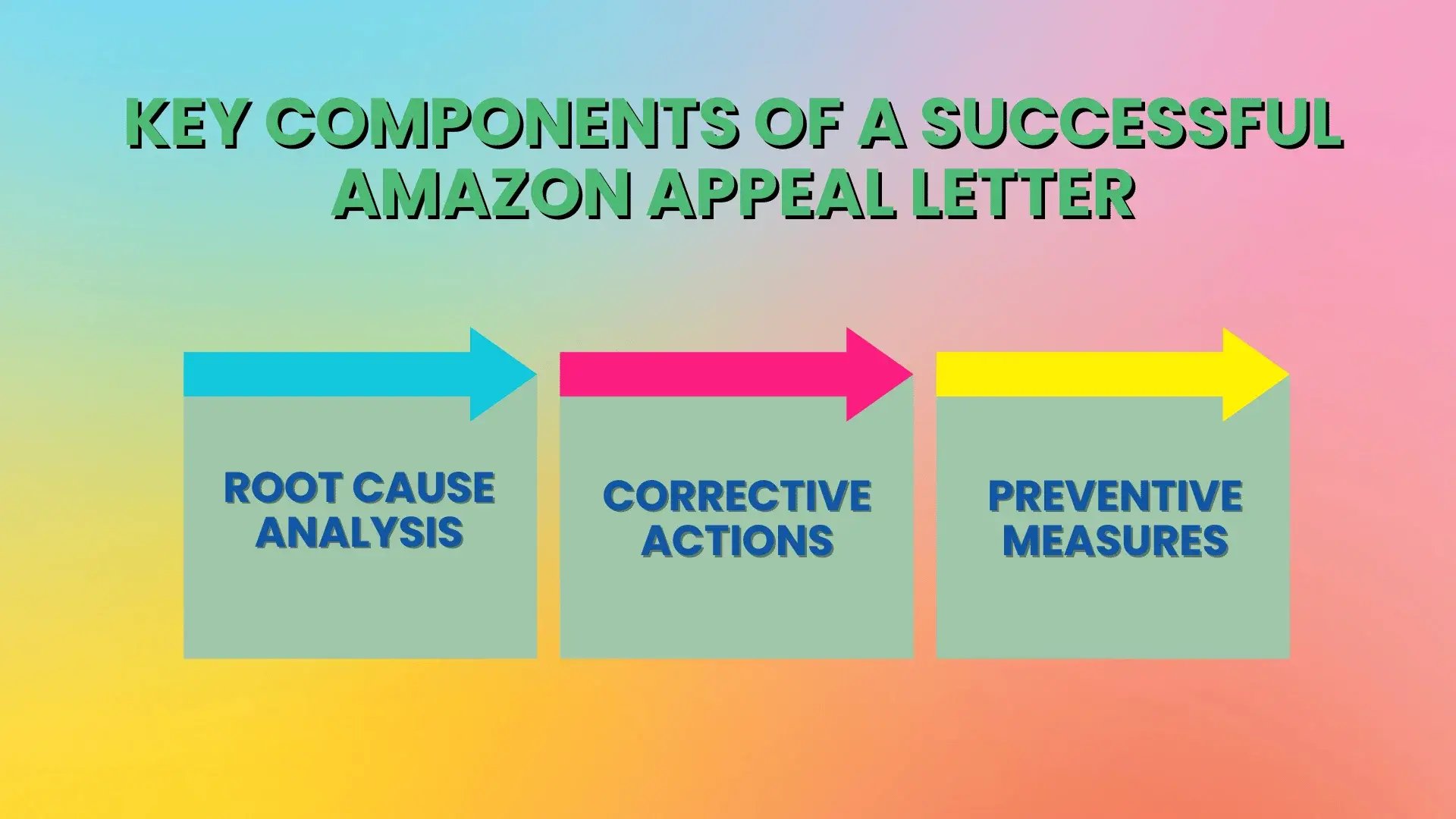
Amazon uses a three-part framework to judge your appeal. Miss any part, and you're getting rejected.
Here's what they're looking for:
Root Cause Analysis
This explains why the problem happened. Not what happened, but why.
Amazon wants to see that you conducted a real investigation, not just made assumptions about what went wrong.
If you say "our quality control failed," they'll reject it. But if you say "our warehouse staff assumed FBA returns were unopened and restocked them without inspection," that shows you dug into the real issue.
Work backward from the customer complaint.
Was it a prep center mistake? Bad inventory tracking? Unclear product descriptions? Supplier quality gaps?
Amazon assumes customer complaints are valid, even when you disagree. Your job is to find where your system broke down.
Corrective Actions
This describes what you've already fixed. Not what you're planning to do. Already done.
Amazon requires completed steps with supporting documentation attached. You need to include specific dates, reference the documents you're attaching, and show measurable improvements.
A strong corrective action looks like this:
"Removed all FBA inventory on January 29, 2026 (Removal Order ID: ABC123). Inspected every unit. Downgraded imperfect items to 'Used - Like New' or liquidated them. Issued proactive refunds to 47 customers with delays over 48 hours."
Specific dates, order IDs, exact numbers, and proof of action.
Preventive Measures
This proves you won't make the same mistake again.
This section often separates approved appeals from rejections. You need to identify specific people responsible, establish clear procedures, and create verification methods to confirm everything is working.
Good preventive measures read like this:
"We appointed a dedicated Logistics Manager to review order forecasts weekly. Established a 9:00 AM daily meeting reviewing the Account Health dashboard. Any 'Unshipped' order older than 20 hours gets immediate priority handling."
How to Write an Amazon Appeal Letter
Before you write anything, read your suspension notice three times. Identify the exact violation Amazon flagged.
Note which ASINs they're targeting. Check if it's performance-based, policy-based, IP-based, or compliance-based.
Cross-reference with your Amazon account Health dashboard.
Then, you need to gather proper documentation.
- For inauthentic claims, you need supplier invoices from the past 365 days with complete contact info, purchase orders, and brand authorization letters.
- For performance issues, pull shipping logs, tracking data, and customer communication records.
- For policy violation appeals, prepare updated listings, screenshots of removed content, and training docs. Everything should be clear PDFs with proper labels.
Remember, structure matters significantly:
- Use headers, bullet points, and numbered lists. No long paragraphs.
- Keep it to 1-2 pages or around 500 words for straightforward cases.
Amazon reviewers process hundreds of appeals daily. They're scanning, not reading every word. Bold your ASINs, dates, and key terms.
Here's a structure that works:
- Brief acknowledgment of the issue
- Root cause analysis (2-3 sentences)
- Corrective actions (3-5 bullet points)
- Preventive measures (3-5 bullet points)
- Request for reinstatement
That's it. Don't overthink it.
When to Get Expert Help with Your Appeal
Writing your own appeal works well for straightforward cases with clear documentation.
But complex suspensions involving linked accounts, IP disputes, or multiple policy violations often need specialized knowledge of Amazon's review process and escalation channels.
Seller Candy is an Official Amazon Service Provider specializing in Seller Central operations and account reinstatements.
Our Amazon suspension appeal service handles the entire reinstatement process:
- Root-cause investigation backed by compliance analysis
- Professionally structured POA that meets Amazon's approval standards
- Complete documentation preparation and case submission
- Direct management of Amazon communication and escalations
- Ongoing support until your account is reinstated
With over 70,000 cases resolved and a 98% success rate, we have helped brands and resellers selling products on Amazon get back to business fast.
If you're facing a suspension that's blocking your revenue, schedule a free consultation to discuss your specific case.
The Role of a Plan of Action (POA) in an Appeal Letter
A Plan of Action isn't separate from your appeal letter. It IS your appeal letter. Amazon uses these terms interchangeably.
When they ask for an appeal, they want a POA. When they request a POA, they're asking for your appeal.
The confusion comes from how people talk about it. Some sellers say "appeal letter" when describing the overall submission.
Others say "POA" when focusing on the three-part structure (root cause, corrective actions, preventive measures).
Same thing, different names.
Your POA needs different approaches depending on your suspension type:
- Inauthentic claim POAs must address sourcing gaps. Amazon's "inauthentic" category includes gray market goods, not just fake products. You need supplier invoices with full contact details (Amazon might call to verify, so those numbers better work).
- Intellectual property POAs work differently depending on whether the claim is real or fake. If someone filed a bogus complaint, submit a counter-notice with your authorization evidence. Ask the rights owner to retract their claim.
If the claim is valid, own up to it. Explain how it happened and show what you fixed. Attach your brand authorization letters or licensing agreements. If you can get the rights owner to send a retraction via Seller Central, that helps a lot. - Performance metric POAs focus on operational factors behind your metric decline. Analyze your fulfillment processes, carrier issues, and staffing gaps. Include shipping records. Consider switching to Amazon Buy Shipping Services for automatic tracking upload.
- Related account POAs are tough. You need to prove zero connection to the flagged account. Usually, these happen because a third-party service (like a VA) accessed your account from shared IP addresses or devices. Submit notarized affidavits, utility bills, business licenses proving you're separate entities, and contract termination evidence with any shared service providers.
%20in%20an%20Appeal%20Letter.webp?width=1200&height=800&name=The%20Role%20of%20a%20Plan%20of%20Action%20(POA)%20in%20an%20Appeal%20Letter.webp)
Amazon Appeal Letter Example
First of all, you should never use a set template. Every case is different.
The examples below are just to show you how to approach your appeal, not what to copy and paste:
For an Inauthentic Product Claim:
Dear Amazon Performance Team,
Thanks for letting us appeal the suspension on ASIN B08XYZ1234. We take product authenticity seriously and want to fix this.
What went wrong: We reviewed the issue internally and traced it back to our supplier's paperwork. Their invoices didn't have the complete business details that Amazon requires. We didn't catch this before ordering.
What we've done:
- Switched to ABC Wholesale, an authorized distributor verified by the manufacturer.
- Got new invoices dated January 30, 2026, with all the info Amazon needs.
- Went through every supplier document we have to check for similar gaps.
- Pulled all inventory for this ASIN and inspected it (Removal Order: 123456789).
We're attaching the updated invoices from ABC Wholesale with their full contact info and product details.
How we're preventing this:
- We only buy from authorized suppliers now.
- Our purchasing manager checks all invoices monthly to make sure they meet Amazon's standards.
- Everyone on the team took Amazon's invoice compliance training.
- We assigned Sarah (our Compliance Officer) to vet any new supplier before we place orders.
We'd like to get ASIN B08XYZ1234 reinstated.
Thanks,
[Your Business Name]
[Contact Info]
For a "Used Sold as New" Complaint:
Why this happened:
We looked at the return feedback for ASIN B07ABC5678. Customers said things like "looks opened" and "box crushed."
We found three problems:
- Heavy products were stacked on top of these boxes in our warehouse, crushing the packaging.
- We shipped them in bubble mailers instead of boxes.
- The manufacturer's tape has weak adhesive that comes loose during shipping.
What we fixed:
- Pulled everything from FBA (Removal Order: 987654321) and checked each unit. Anything that wasn't perfect got marked as "Used - Like New" or sent to liquidation.
- Reorganized our warehouse so that light items never go under heavy ones.
- Switched to stronger 32 ECT boxes. No more bubble mailers for this product.We shipped them in bubble mailers instead of boxes.
What we're doing going forward:
- Adding tamper-evident seals on top of the manufacturer's tape.
- Turned off FBA Repackaging. We inspect all returns ourselves now before sending them back.
- Taking photos of every shipment we send to FBA for our records.
[We're attaching: photos of old vs. new packaging, the QC checklist we use now]
Common Amazon Appeal Letter Mistakes
Even well-intentioned appeals fail when they include these critical errors:
- Generic Templates: Amazon reviewers scan hundreds of appeals daily and spot copy-paste content instantly, including ChatGPT-generated text. Amazon's Seller Performance teams are trained to scan for superficial language and templated POAs.
- Failure to Identify True Root Cause: Surface-level explanations such as "there was no issue" or "we apologize for the inconvenience" are immediately rejected. Amazon wants proof that you dug into what went wrong and understand the system failure.
- Vague Corrective Actions: Phrases like "we will be more careful" or "we are committed to quality" mean nothing. Actions must describe concrete, completed changes, including dates and evidence (as shown above).
- Submitting Identical Appeals: Amazon's system flags duplicate content after rejection. Each rejection makes reinstatement harder. Every resubmission requires substantially revised content, deeper analysis, and more documentation.
- Documentation Failures: Common problems include incomplete invoices, missing supplier contact details, low-resolution or altered documents, files that don't match the cited ASINs, and retail receipts (from Walmart, Costco) instead of wholesale invoices.
- Blaming Others: Don't blame Amazon's system, customers who left negative feedback, competitors who filed false complaints, or suppliers who screwed up. Take ownership and show what you're fixing.
- Emotional Language and Legal Threats: Phrases like "this is unfair," "I'm losing my livelihood," or "my lawyer will contact you" get your case flagged and often ignored. Stay professional and solution-focused.

Frequently Asked Questions (FAQs)
Brands and resellers selling products on Amazon frequently ask us questions about Amazon appeal letters:
What Is the Average Response Time for Amazon Appeals?
Amazon aims for 48-hour responses, but reality varies. Simple cases typically get answers within 24-72 hours.
Complex suspensions like Amazon IP complaints or linked accounts can take 2-6 weeks or longer.
Can Appeal Letters Differ for Account vs. ASIN Suspensions?
Yes, they're very different. ASIN appeals focus on specific product issues, supported by product-level documentation.
Account appeals require comprehensive, business-wide plans that address all flagged issues with stronger evidence and systemic fixes.
How Many Times Can I Submit an Appeal Letter?
Amazon doesn't put a hard limit on appeals, but they warn that you could get permanently banned after two failed attempts within 17 days. Each time they reject you, getting reinstated becomes harder.
After a few rejections, try escalating to Executive Seller Relations or work with Amazon reinstatement specialists who know how to handle tough cases.
Do Third-Party Services Guarantee Reinstatement?
No one can guarantee Amazon will approve your appeal. Amazon makes the final call, always. That said, experts who know Amazon's review process inside and out get way better results than most sellers trying to figure it out alone.
They know what Amazon looks for and how to present your case properly.
Conclusion
The difference between approval and rejection often comes down to evidence quality and how well you address Amazon's specific compliance concerns.
Most brands and resellers selling on Amazon underestimate the precision required for your POA or miss critical documentation requirements.
Seller Candy takes over the entire appeal process. We identify the real compliance issue behind your suspension, draft a targeted Plan of Action that meets Amazon's approval standards, and handle all case submissions and follow-ups.
Our team has resolved over 70,000 cases with a 98% success rate. Every day your account stays suspended costs you sales.
Book your free consultation and let's get your account reinstated.